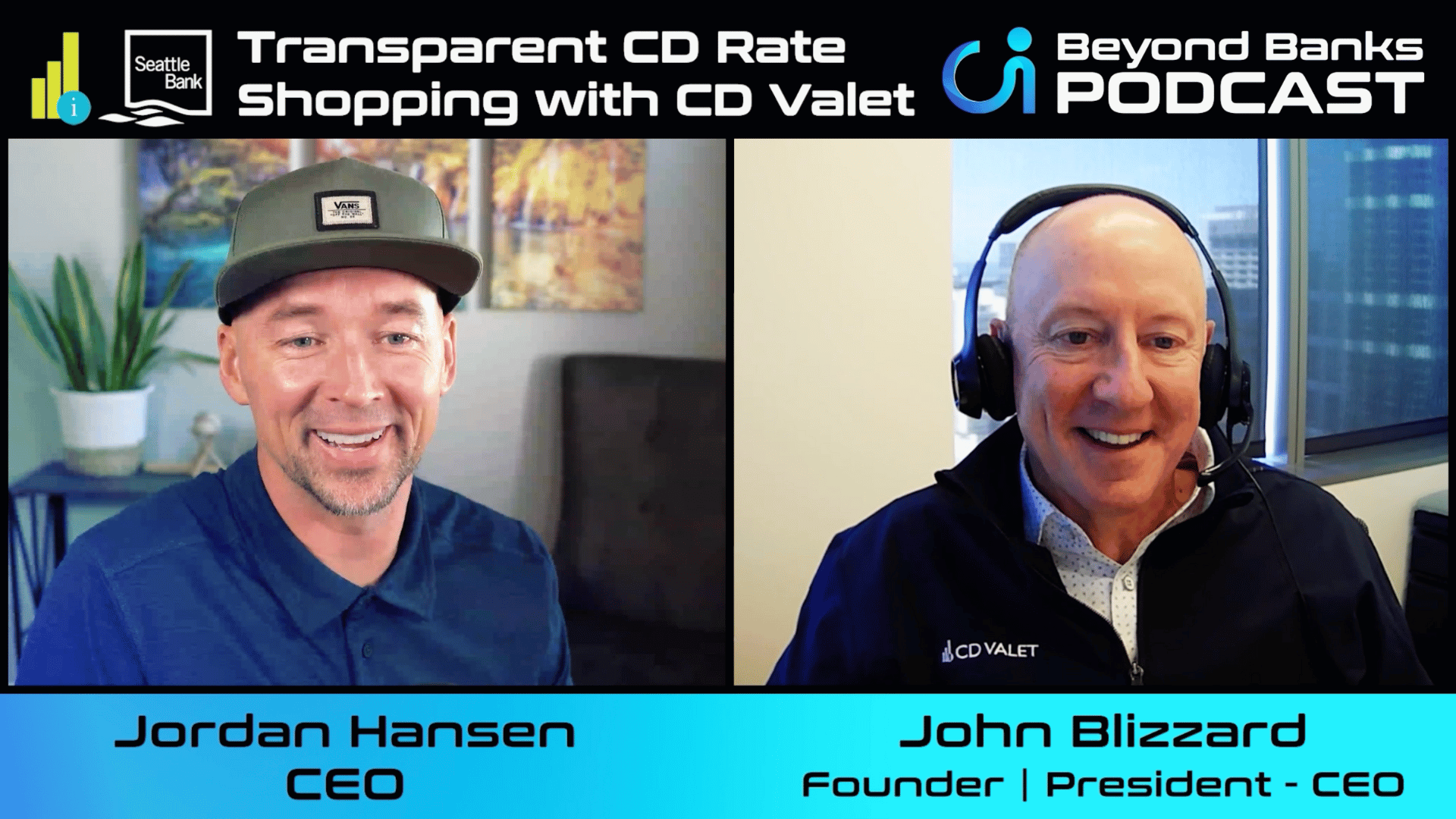
In this episode, Seattle Bank CEO John Blizzard joins host Jordan to discuss how an overlooked corner of finance — the certificate of deposit — is becoming a hotbed for digital innovation. Through CD Valet, Blizzard and his team have built a transparent, data-driven marketplace that empowers consumers to compare CD rates nationwide while helping community and regional banks attract deposits more efficiently.
The conversation explores three key trends reshaping consumer banking:
- Deposit transparency as a new form of trust. Traditional affiliate marketplaces obscure real rates, but CD Valet levels the playing field with unbiased data access.
- The rise of “smart money.” Today’s savers are sophisticated, digitally fluent, and value-driven — not the “hot money” stereotype of old.
- Community banks going digital. As the deposit landscape shifts, smaller institutions are learning that digital competitiveness isn’t about technology alone — it’s about execution, speed, and customer experience.
Blizzard argues that the future of fintech lies not just in lending or payments, but in modernizing the deposit side of the balance sheet — the foundation of banking stability. His insights reveal how innovation can emerge quietly, through transparency, data infrastructure, and consumer empowerment.
For fintech professionals, investors, and lenders, this episode delivers a compelling look at how the next wave of disruption will come from rebuilding banking’s core — not reinventing it.
How CD Valet Is Redefining Deposits in a Digital Banking World
John Blizzard, as president and CEO of Seattle Bank — and the founder of CD Valet — has the measured cadence of a banker who’s seen the cycles, felt the regulatory waves, and still believes there’s room for reinvention.
That belief has landed him squarely at the intersection of two major trends shaping finance today: the digital transformation of consumer banking and the rediscovery of deposits as a growth engine.
“When you’re running a bank,” Blizzard says, “you have to evolve with the world. You have to find where you can add value — where there’s an underserved customer base — and then do something cool for them that brings real value.”
It’s that mindset that led to CD Valet — a deceptively simple platform that solves a deeply entrenched problem: how consumers and community banks connect over one of the oldest financial products out there, the certificate of deposit.
The Problem No One Was Solving
Blizzard’s story starts where most banking reinventions do — with frustration.
In 2018, Seattle Bank was growing, funded largely by wholesale sources and brokered CDs. The goal was to pivot toward more retail deposits. But the digital marketplace wasn’t built to help community banks compete.
“We were way behind,” Blizzard recalls. “The consumers weren’t getting the best deals, and we couldn’t get visibility. The only ‘marketplaces’ out there, like Bankrate or NerdWallet, were affiliate-based — they only showed offers from institutions paying referral fees.”
The result? A marketplace that wasn’t really a marketplace at all.
Consumers looking for the best CD rates had to open dozens of tabs, hopping from local banks to credit unions to obscure online players. And community banks — often offering competitive rates — couldn’t get noticed.
Micro-Takeaway: Digital transparency is the new trust currency. In a world of affiliate-driven listings, a truly open marketplace becomes a differentiator.
The Birth of CD Valet
Instead of accepting the status quo, Blizzard built a workaround.
Launched in late 2021, CD Valet functions as a neutral data platform that tracks every publicly available CD rate from banks and credit unions nationwide — more than 38,000 products, updated weekly.
To the average consumer, it’s a clean comparison site. To industry insiders, it’s a data engine that changes how deposits are sourced and priced.
“We just thought it was crazy that there was no place where a consumer could see all their options,” Blizzard says. “So we built it. And for banks, if you want to be competitive and raise deposits, you can do it in a hurry.”
In its first three years, CD Valet has drawn four million users and partnered with over 50 financial institutions. But the bigger story isn’t growth — it’s timing.
As lending margins compress and rates remain volatile, the deposit side of the balance sheet is suddenly sexy again. Fintechs built on lending are pivoting toward deposits. Traditional banks are rethinking acquisition costs.
Micro-Takeaway: The next frontier in fintech isn’t payments or lending — it’s deposits. Whoever controls the flow of consumer deposits controls the foundation of banking stability.
Hot Money, Cold Reputation
Inside the industry, CD customers have long carried a stigma. Regulators and bankers once called them “hot money” — fickle funds that disappear the moment a better rate appears.
Blizzard disagrees.
“The reality is, the world’s moved on,” he says. “Somebody might keep a checking account, but if they’ve got extra money, they’re going to put it somewhere that earns more.”
His team’s research backs it up. The U.S. CD market represents roughly $3 trillion in deposits, spread across 30 million consumers. Many of these individuals — the “Savvy Savers,” as CD Valet calls them — hold between $50,000 and $5 million across multiple institutions.
They’re disciplined, data-driven, and extremely comfortable managing their own finances.
“These are do-it-yourself investors who want absolutely conservative investments,” Blizzard explains. “They see insured deposits as their version of the stock market.”
In other words: not hot money, but smart money.
Micro-Takeaway: In a market obsessed with customer acquisition, ignoring a $3 trillion pool of conservative, loyal capital may be fintech’s most underpriced mistake.
When Community Banks Go Digital
For community and regional banks, the digital age has been both liberating and intimidating.
They’ve long prided themselves on relationships — the ability to walk into a branch and talk to someone who knows your name. But as consumer behavior shifts online, many smaller institutions struggle to replicate that intimacy digitally.
CD Valet offers a kind of bridge: banks can list rates, tell their story, and connect directly to customers through an “Open Now” button that links to their digital account opening platform.
“It’s not very technical,” Blizzard says. “We can set them up in a week. But the real work is in having a great digital process — seamless ID verification, smooth funding, trained staff behind the scenes.”
Seattle Bank has perfected that process internally, completing 1,500 CDs in six weeks during one campaign — with minimal staff overtime and zero customer complaints.
Micro-Takeaway: In digital banking, conversion isn’t about technology — it’s about execution. Every click a customer hesitates on is a lost deposit.
Competing for Deposits in a Transparent Market
The irony of modern banking is that institutions are awash in data but still under-informed about cost of acquisition.
“Most banks don’t really know their CAC,” Blizzard notes. “You can offer a 3% CD and think you’re getting cheap deposits — but if you spent a ton on marketing, it’s really more like 8%.”
That calculus changes on CD Valet. By aggregating intent-driven traffic — consumers actively shopping for CDs — the platform lets banks capture deposits efficiently.
It’s also introducing a new kind of market discipline. If transparency defines consumer trust, it also forces institutions to compete on performance, not proximity.
“If you’ve heard of one bank and not the other, that name recognition might matter,” Blizzard says. “But if two offers are equal, you’ll pick the one that makes the process easier.”
Micro-Takeaway: In the digital deposit market, UX is the new brand. A smooth account-opening flow beats a familiar logo every time.
The CD Renaissance
CDs aren’t supposed to be exciting. Yet, for the first time in decades, they are.
As the yield curve remains inverted, high-yield savings accounts have offered better short-term returns — but that’s changing. As rates flatten and potentially decline, CDs may reclaim their place as the preferred savings vehicle.
Consumers are already paying attention. “We’ve had campaigns where banks fill up fast,” Blizzard says. “They raise a ton of deposits in days. These are savvy customers who know a good deal when they see it.”
And unlike a fleeting fintech trend, this shift taps into something enduring: a demand for fair value.
“Banks have been too focused on low-cost deposits at all costs,” Blizzard says. “Consumers are saying, ‘Treat me fairly, give me a good deal, and I’ll bring you my business.’”
Micro-Takeaway: The new loyalty loop in banking isn’t emotional — it’s rational. Transparency and fairness are the strongest customer retention tools left.
A Mirror for Banking’s Future
What CD Valet represents, in Blizzard’s view, isn’t just a marketplace — it’s a signal.
It’s proof that even in a heavily regulated, slow-moving industry, innovation doesn’t always mean invention. Sometimes it’s about fixing something quietly broken — the unglamorous but vital machinery of deposits, rates, and retail access.
It also illustrates how AI and data infrastructure are transforming banking in less visible ways. CD Valet’s next phase will leverage AI to personalize rate discovery, predict rollover timing, and deepen engagement between consumers and institutions.
If that sounds unremarkable compared to blockchain or DeFi, that’s precisely the point. Fintech maturity looks less like hype and more like plumbing — invisible, reliable, indispensable.
Micro-Takeaway: Fintech’s next wave won’t disrupt from the edges; it’ll modernize the core. Deposits, credit, and trust are where real transformation happens.
The Bigger Takeaway: From Hot Money to Smart Market
Blizzard’s career arc — from teller line to CEO to founder — embodies a larger truth about banking’s evolution. Institutions that survive aren’t necessarily the biggest or flashiest; they’re the ones that learn to see opportunity where others see inertia.
CD Valet may have started as a tool to help one bank source deposits more efficiently, but it’s fast becoming a model for how the industry might rebuild trust, transparency, and fairness in the digital era.
For fintech founders and investors, the lesson is clear: the frontier isn’t just about inventing new products — it’s about making old ones work better.
“You can’t ignore digital,” Blizzard says simply. “I don’t think the Internet’s going away anytime soon.”
Main Takeaway: As banks race to digitize lending and payments, the quiet revolution is happening on the other side of the balance sheet. The winners won’t be those chasing trends — they’ll be the ones rebuilding the foundation of consumer banking itself.
Interview Transcript: John Blizzard - CD Valet
Jordan: Hello and welcome everyone. I'm here with John Blizzard, who is the president and CEO of Seattle Bank, and also the founder and CEO of CD Valet. I'm really excited to talk to you today. Uh, John, you've been heavily into finance, but kind of gimme some background on you and, and kind of what has led you down this path of like into finance so heavily where you are.
John Blizzard: Yeah. Uh, thanks Jordan. Good morning to you. Uh, yeah. You know, not unlike many bank CEOs, uh, I started out on the teller line long, long time ago in, uh, Bartlesville, Oklahoma. Long way from Seattle. But I, you know, I worked in a variety of areas, retail banking for a short stint when I was young. Then got into mortgage banking for a number of years when I came out to the Seattle area, worked for the Federal Home Loan Bank of Seattle, where we lent money to banks, the biggest banks in the country to community banks. Spent seven years doing that and, uh, so really a varied background and experience. Uh, was a CEO of another bank for a couple years, and then been, uh, at Seattle Bank for 11 plus years on this stint. I was a mortgage banker here, ran a division back in the nineties for seven years at Seattle Mortgage Company, which is owned by Seattle Bank. And so I guess all told I'm more like 18 years at the company. Yeah. And uh, it's been a, been a great run. Been fun.
Jordan: So lots of questions already, but I'm kind of curious. I'm gonna just start here. At a bank, let's say like Seattle Bank for example, or kind of the banks you see just by drive around the banks I see around and maybe credit unions as well. What, what percentage do you say is mortgage?
John Blizzard: Boy, it really depends. You know, it used to be you had thrifts that were a particular kind of bank that that's, you know, that's predominantly what they did was mortgage lending. And that market has shifted dramatically after the great financial crisis. The big banks got outta like government lending, FHA and VA lending. So it's really shifted to the mortgage bankers versus the banks, which is pretty unfortunate. It's a pretty core product, that financial product that consumers use. And, uh, the regulation and everything after GFC was so stringent on the banks. They just really lessened their involvement in that space. Maybe we'll see some changes, uh, going forward there, but it's predominantly dominated by non-banks now.
Jordan: Interesting. So when you say mortgage banker, gimme an example. What's a mortgage banker?
John Blizzard: Yeah. So, uh, yeah, so mortgage banker would be if, uh, or mortgage broker is somebody who's not a bank. They really are originating and selling those loans to someone else. Usually they end up in a securitization. So there can be, uh, a variety of different kinds. But, uh, yeah, basically it's not a bank that you're dealing with, but they're selling loans. They do big volume and um, you know, there's lots of 'em out there.
Jordan: Got it. So that means that ultimately these notes are probably held by just a small amount of parties, is kind of what's happening.
John Blizzard: Well, they end up in a huge amount of securitizations out there in the marketplace that investors, you know, pensions and others, uh, own the mortgage market is enormous. I, I forget if it's $10 trillion or something. Mm-hmm. That's significant. And so they, you know, we all own it in our 401Ks and, and other things, um, you know, it's institutional money, so, um, but it's really that front end that changed so much and it was, uh, you know, less so the banks originating and the, and the non-banks coming in.
Jordan: Got it. So then I'm talking to a broker. So if I'm wanting to buy a house, I'm gonna talk to probably a, a mortgage broker like you said, or mortgage banker, kind of the same thing. Um, yeah. Rather than walk into my bank.
John Blizzard: Yep. I mean some of the banks still do it, um, just to a lesser degree than they used to do.
Jordan: They say, no, we don't wanna do that right now, or refer you what? I mean, I'm just, just curious.
John Blizzard: Well, some do, some originate some business or have like decent mortgage, um, operations, but it's just not to the degree it used to be. Um, and some don't do it at all. So lots of commercial banks don't really do mortgages. Yeah. Um, so most, most credit unions still do to some degree.
Jordan: Now, when you were going through your background, you mentioned mortgage a lot. You were, you were involved a lot in mortgage. It sounds like a big part of your career was there, and like you said, you were kind of bummed out that that's not part of it. Is that just because it's like such a good - you're serving the consumer, and so obviously you wanna be able to provide all the products to them. Is that kind of why it's a bummer?
John Blizzard: Yeah. It's, it's unfortunate for the industry that the banks aren't involved in that as much because they play such an important role in their communities and, and not offering mortgages, not being in that space is, uh, yeah, it's just, it's an unfortunate area, but hey, the world changes and evolves and, uh, you know, you have to evolve with it when you're running a bank. A bank is a business. And, um, you know, you have to find the areas where you can add value, like what we've done with CD Valet, which is on the total opposite side of the balance sheet, it's the deposit side. Mm-hmm. And so, um, really finding ways to like, Hey, where's an underserved customer base? And where can you do something pretty cool for them to bring them value and, and find a way to get paid for it.
Jordan: So, yeah, let's go into that. So, CD Valet. Um, tell me more about it. What, what drove, what made you think? I mean, it's been three years almost, almost next month, right?
John Blizzard: Yeah. Three years, next month.
Jordan: Where did you see the need? What, what drove the decision to start CD Valet?
John Blizzard: Yeah. It actually started a long time ago. Uh, probably like seven, seven years ago or so, 2018, uh, we really started Seattle Bank learning, uh, about the digital marketplace and how hard it was to compete digitally. And so we had a lot of growth in 2018. We had funded that with wholesale funding, brokered CDs and advances from the Federal Home Loan Bank. And um, and we were like, Hey, we need to replace that with retail customers. We're not gonna be able to generate checking and savings accounts nearly fast enough to, to bring in what we wanted. So we went after the CD business and that's when we started really learning about the marketplaces that were out there.
Jordan: And, and sorry to clarify, you mean Seattle Bank did this?
John Blizzard: Yes. Seattle Bank. Yeah. Uh, that was Seattle Bank. It is like a lot of things, we just discovered a problem or an issue and, uh, went out to solve it. And the problem was like community banks and credit unions were just completely ill prepared, way behind to compete digitally against the big internet banks who were very sophisticated online. They worked with the digital marketplaces, you know, like a Bankrate and NerdWallet, some of those that were really, I call 'em kind of fake marketplaces. Uh, in that they only showed you a small segment of what was available and it was only the ones that they were getting paid on.
Jordan: It was affiliates.
John Blizzard: Yeah, they just want the, they wanted the referral fee. Yeah. Yeah. Nothing wrong with that. As a business model, those were very successful. Um, but the consumers on CDs - it's a pretty generic product. Right. It's a pretty commoditized product, and there was nowhere for the consumer to go online and find out all their options. They would have to literally go from website to website from banks in their market, out of their market, credit unions, et cetera. And it was crazy to us. There was no place that we could, we could just go advertise and show our rate and get the, um, the traffic. And so, you know, we did all the Google AdWords and all that stuff that you do, but you know, it's a very sophisticated digital marketing world, SEO and so forth in that space. You have, you know, experts that were in there. And so, um, anyway, so we discovered like, hey, we were way behind. The consumers were not getting nearly as good a deal as they could get. And it was like, Hey, how do you marry those two things? We had a nice offering, I think it was like 2.5% back then - nice offering then, right? - for like a two year. Right. And um, so we had a really good offering back then that consumers didn't know about. And um, like how do you marry those? How do you get the consumer to find you and how do we get access to consumers more cheaply? And so we set out to do that. The other thing we really discovered is this is a massive, massive market and nobody ever talked about it because it was considered hot money. You know, nobody in the industry thought favorably of the CD customer.
Jordan: So why hot money? I don't know if I've even heard, I saw, I've seen that on your website. What is hot money? Tell me more.
John Blizzard: Uh, it's, it's a legacy thing where, uh, you know, bankers and regulators say, Hey, somebody that's just putting money with you, like for a CD, is, uh, it's transactional. If you have any problems, anything, they'll take their money and leave.
Jordan: Ah, so it's not like a depository where they're hanging out.
John Blizzard: Right. They're gonna be a long-term customer. The CD versus you have a checking account, they stay with you forever. Now, the reality is the world's moved on. Somebody might keep a checking account, but if they have a lot of extra money, the checking account might exist, but they're gonna put that other extra money in a, in a different account somewhere.
Jordan: Yeah. There's no interest on, yeah.
John Blizzard: Yeah. Oh yeah. Sure. But what we, what we discovered is the market for CDs, these customers, and I met with many of them back, back then, and uh, as we ran campaigns and learned, and we did research through the Fed and other things, is it is, you know, huge, you know, 30 million plus consumers and we see average transaction size 50 to a hundred thousand dollars. And many of these consumers have, you know, a million dollars or more invested in CDs. What it is, is it's a very do it yourself investor who wants absolutely conservative investments. They're very comfortable working with banks and credit unions, having insured deposits, and that's what they like doing. That is their stock market. And so that, um, it just happens that is a very big market today. That's 15% of deposits, nearly $3 trillion with a T, so it is a massive amount. Banks have done it begrudgingly to go out and get high cost deposits. Right? And so, uh, but they've done it because they couldn't get enough of the other kinds of deposits, right? They prefer to have zero cost checking accounts, right? But here, hey, we live in an era of the, uh, uh, we live in a world where the internet and information is out there. Consumers are getting wiser by the day. And the industry just kind of, you know, has built around these low cost deposits at all costs, no matter how much money they had to spend to get 'em. Uh, but that's changing now where banks are realizing, Hey, to compete and get the deposits we need, you know, we gotta be competitive in the CD market. So we created CD Valet so that financial institutions can get on the site. Let me back up. We track all the rates of all the banks, all the credit unions that have public rates in the country.
Jordan: How exactly?
John Blizzard: We have 38,500 different CD products are tracked weekly, updated on our site. You can see 'em all on our site if you want. You can track by state, maturity, all these things. It's the most comprehensive list anywhere. Um, so we put that out there for our consumers. We had 4 million people to our site. Uh, and we're just really getting started. Uh, especially as we enter the AI world, our traffic numbers are gonna accelerate significantly because we have the best data of anyone by far. And, um, yeah, so it gives consumers this great choice, but we allow the banks if they want, or credit unions if they want to be actionable on our site, we have an open now button next to your name. The customer can hit that button. It goes right to your digital account opening solution. Hmm. Most banks, if they're, uh, digital oriented, will have a digital account opening solution. We can set 'em up in a week. It's not very technical. And we drive that lead right to their, um, right to them. It's a real customer going to them. It becomes, you know, uh, it becomes their retail customer. These are not brokered. They get the opportunity to cross sell 'em other products. We've done that at our bank, um, with great success. And these are customers with a lot of money. I mean, our last campaign that we ran, uh, average CD was, uh, a hundred thousand dollars. Hmm. And did 1500 of them in six weeks.
Jordan: Wow.
John Blizzard: So it's like, these are - we call 'em Savvy Savers. They know a good deal when they see it. If you want to be competitive and raise deposits, you can do it in a hurry and we're all about driving that value to these consumers. And we think banks have just been - outside of their wealth management arms, they've been too focused on the low cost deposits at all costs, if you will. Which has been fine, but it's like, hey, you have a big consumer base that is really saying, you know what, if you want my business, you gotta treat me more fairly and I gotta get a good deal. It's kinda like, you know, Walmart has everyday low prices. Uh, you come to CD Valet, we have everyday great rates on CDs. Um, so it's kind of a, uh, version of that.
Jordan: I'm kind of curious, you talked a little bit about the demographic. You said maybe baby boomers, someone that's - when are they making this decision to put it in a CD? And I'm kind of curious, like the duration, like how are they choosing? Okay. Like why, why would they choose that versus the stock market? Is it, I mean, it's not liquidity because, you know, it's locked up for X amount of time. But maybe, like you said, conservative, they want that money. They don't wanna have any risk, you know, the stock market's great over the long term, right? You don't wanna try to predict that it's not gonna drop in the next six months if you have a short term goal. Can you walk me through more of that, like, choice of demographic and when are they making that decision to go CD versus, you know, high yield savings or the stock market directly?
John Blizzard: Yeah, and you got multiple different kinds of, uh, personas we call 'em. So you have the Savvy Savers. These are people with a lot of money. They track the markets very closely, but they're very conservative, so they might own bonds and some other investments. Um, some stocks. Yeah, but they own a lot of insured deposits around different banks. We've seen people with CDs at 20 different banks. Right? Yeah. Um, spreading 'em out for the insurance, spreading 'em out to get the best deals. And so those savvy savers are very focused on, on what's going on in the market.
Jordan: What percentage of their, of their net worth would you say is in CDs?
John Blizzard: Uh, you know, it's probably pretty high, probably 60% or more outside of their house. Uh, yeah, we've seen CDs, you know, uh, people with CD balances well north of $5 million. Hmm. Um, again, this is a demographic that doesn't have wealth advisors typically because they don't trust them or because they like to do it hands-on. They wanna do it themselves.
Jordan: All of the above.
John Blizzard: Yeah. They are hands on and, um, you know, they, um, yeah. And there's a lot of them out there, right? It's, it's, this is not a sexy, uh, area for banks to typically go after. Banks wanna do lending. These people, for the most part, are not borrowers. Mm-hmm. Um, banks want wealth management. We're gonna make fees. These folks are generally not interested in wealth management. Huh. Um, you know, so it's an interesting, uh, demographic, but it's like 55 plus. Um, we certainly have some younger consumers as well looking to do CDs. But um, yeah, as far as the stock market goes, like, hey, they're risk averse. Um, certainly you have some consumers out there that have some money in CDs, you know, maybe they're saving for an event. We might call 'em an event saver. They're saving to buy a house, buy a car, college education. Yeah. But the Savvy Savers, they'll have CDs for five, 10 years, 15, 20 years. And they're just rolling those all the time. Um, you know, and in large dollars. So yeah.
Jordan: Especially right now, like I was looking on your site earlier. I mean, rates 4%, four point - that doesn't seem weird. Right? That's all very easy to obtain with some of those, those -
John Blizzard: Oh yeah, yeah, yeah. And we have great deals and, uh, I mean, we'll, we'll, some of - you'll get filled up. A bank will be real aggressive and they get a lot of business in a hurry. Um, that's the other thing I would just say, like, typically banks don't really know what their CAC is. Client acquisition cost is not something we're good at in the industry of knowing, um, what it costs. So say somebody generates a client and they have a 3% CD, I'll, I'm just use an example, but they spent, you know, enormous amount of money on marketing. Mm-hmm. Well, the 3% didn't make a hell of a lot of sense. Yeah. 'cause it really was like 8% by the time you paid all your marketing. So, you know, there's this balancing act of like, hey, on our platform, we have very sophisticated clients. If you can come and pick a point on the curve compared to the competition and offer something competitive, you can get a lot of business, um, and lower that CAC. So make your conversion more successful. Yeah. So we'll say one thing. We have, we've worked with over 50 financial institutions directly offering, uh, you know, open now, um, actionability on CD Valet and I've talked to probably a couple hundred more. And so one thing we see is a very big divergence in the abilities to, um, convert successfully digital leads. So in a branch, if you're having issues or something, somebody may sit with you an extra 30 minutes to get through the process. Right. Printer has problems or whatever. Digitally, if they don't have a good experience, they're out. Mm-hmm. You don't get that 30 minutes. So you have to have a very good, uh, a very good process. So it's not just the technology. You need really good technology on the digital account opening side, but then you need all the processes around it. You need people that are really well trained. Consumers get stuck at IDV, uh, ID verification and funding. You gotta build really good processes around that. And so, um, we see it both at our bank and CD Valet. Um, we've become very much experts at Seattle Bank at this. We did a recent campaign, did 1500 CDs in six weeks with a relatively small team that barely had to work any overtime and no customer complaints, lots of kudos. Um, but we've built it over years having that kind of digital plus trained team. Um, but we do see that as being a big weakness with a lot of the banks. They just don't have the execution around that. Um, and so it's a big opportunity to improve, you know, sometimes they're layering this into a branch bank system. Mm-hmm. And so they're asking folks in a branch to do digital account, you know, work with digital customers. It's just, you know, it has to be a priority and you can't just kind of, it can't be half time there where sometimes they're helping people in -
Jordan: Yeah, exactly. Yep, I get it. And you gotta be monitoring, like, they're not in front of you complaining, they're just leaving your site, so you better be tracking where they're falling out and stuff.
John Blizzard: So anyway, we see that as a big kind of unknown in the industry about success. And we call it conversion, your conversion rate. It's just critical to get really good at that. The internet banks, the big four or five internet banks, Ally, Capital One, et cetera, you know, they have a trillion dollars in deposits. Most of those were done, uh, pretty much online. Yeah. And so they got really good at it over the last 20 years. And I mean, they alone, I think last time I checked, had 300 plus billion in CDs, trillion in deposits. Um, but they got good at it over a long period of time to do that. And that's the bar we all need to match. If you're gonna compete digitally, maybe if you don't have to compete digitally, good for you.
Jordan: Everyone should probably eventually, right?
John Blizzard: Uh, I would think it's probably not a good idea to ignore that. Yeah. I don't know if Internet's going away any time soon. Um, so rates, let's talk about rates. CD rates.
Jordan: You know, I watch the interest rates and how that affects, you know, my high yield savings and I watch how it affects, you know, payments, loans. Um, I gotta imagine the cost of capital's cost of capital. CD rates are somewhat tied to the, you know, the fed and the interest rates in general. But if you have a site where you can compare 'em like yours, that means there must be wiggle room where someone's like, Hey, we wanna drive these so we're gonna increase our rates. Like, why would I pick one with a lower rate? Uh, assuming the timing's the same, right? Yeah. And the requirement of deposit matches what I want. I'm gonna pick the one with the best rate, almost for sure. Unless that conversion flow is bad, right.
John Blizzard: Yep. It's like the name recognition could help somebody. If you are looking at two and you've heard of one and not the other, uh, you can. Um, and that's why we, on CD Valet, you have your own homepage on there for a community institution maybe nobody's ever heard of. They get to tell their own story, you know, put pictures, uh, really give the customer, you know, some comfort around who they are. Um, but it is, the differences of the rates are the same. It's like, yeah, what's the name recognition, um, what's the digital account opening experience. Mm-hmm. That's huge. And if you have a lousy one, they're gonna drop very quick. Um, so it makes a big difference. But yeah, like, hey, most consumers wanna make more money on their money, not less. Yeah. And, uh, that's the whole goal. But I'll say, you know, rates, um, particularly CD rates - CD rates are loosely tied to the treasury curve and um, you know, more like high yield savings. Yeah. Everything is. So high yield savings, money market is probably much more tethered to Fed funds. Um, but the reality is it's, um, these are not all capital markets. The banks and credit unions have to get real customer deposits in their institutions. Ah-huh. So they have to compete day in, day out. So if they have a need for those deposits to fund loans, for example, they're gonna have to be more competitive. If they don't have some other source of deposits they can move quickly on, they're gonna have to be more competitive. So that's why you see a big difference and, uh, different rates and different approaches. The banks, there's been a number of banks that have used the HYSA, the high yield savings account as their strategy over the last several years. Been a good strategy. Alternative, good alternative to CDs. That is likely those rates for consumers - a lot of money in those - as those rates go down, we've had an inverted yield curve. I mean, you get a better rate on your HYSA than a CD oftentimes. You're gonna probably see that flip and you're gonna see a lot of money flow outta HYSAs into CDs. And so, um, you know, so the customers are paying attention and there's different strategies for the banks. The other thing for the banks is their interest rate risk appetite and, um, thresholds. And so a lot of 'em have been short 'cause they've anticipated rates going down. They've wanted their best rate to be a nine month CD. Mm-hmm. Super common. Um, but at some point, you know, hey, it might make sense to lock in longer deposits on a CD that's three years and go out and make that commitment. Plus, by the way, a three year CD versus nine month - nine month, you gotta renew it every nine months and they get a chance to walk out the door. Yeah. Three years, locked up for three years. Yeah.
Jordan: There's all these like elements to consider. Yeah. You gotta keep that money in your door. I mean, like you said, they're trying to manage deposits. If you have a guaranteed three years where you're gonna be sitting on that deposit, that's not nothing. Uh, for sure.
John Blizzard: Yeah, for sure. And so, you know, if that fits with your ALM, your asset liability risk profile, uh, of your institution, that can be a great strategy. Yeah.
Jordan: Well, John, I really appreciate your time. This has been fascinating. Where is the best place for people to find you? Would it be CD Valet? Is that the best place? That's where you'd redirect them?
John Blizzard: Yeah, absolutely. Contact us at CD Valet. I'd love to talk to anybody in the industry, uh, about CD Valet or their own operation and what we've learned at our bank as we've gone down this, uh, this awesome trail with CD Valet.
Jordan: I appreciate your time, John. Thank you so much.
John Blizzard: Alright, take care.
Jordan: You too. Bye.
End of Transcript







.png)











.jpg)


.png)